VISUAL SELF-STUDY GUIDE / NON-DEVELOPER TO NON-DEVELOPER
Build AI web apps with text, image and sound APIs
Turn a small service idea into a clear input, a controlled generation request and a usable result. This English guide is written from Haerang Yoo's experience planning and launching AI services with AI-assisted coding at Lucete AI Lab.
Read the free 6-page visual sample Get the complete kit for USD $29
The flow: input, service guide, API, result
A short user request is only one part of generation. Your service adds fixed instructions, validates allowed choices and turns the provider's response into something the user can copy, download, replay or save.
| Output | Customer input | Service decisions | Usable result |
|---|---|---|---|
| Text generation | Facts, purpose and language | Voice, separate fields, length and fact checks | Named text fields with copy actions |
| Image generation | Subject and permitted choices | Style, palette, composition and exclusions | Image preview and saved asset |
| Sound generation | Brief and texture choice | Instrumental base, direction, supported duration and format | Audio file with playback and download |
A small example you can specify today
New fictional exercise: a café needs a Saturday tasting announcement. Start with a form for the event facts and two text fields: announcement and action line. Ask the AI coding assistant for a labelled mock, then connect one text API on the server. Validate the returned fields before displaying them.
After that works, add a separate illustration with a fixed palette and clear copy area. Add an optional instrumental sound preview as another independent generation step. If the sound fails, keep the successful text and image visible and retry the sound alone.
Basic and applied routes
- Basic: define one output, preview a mock, connect one API, display the real result and handle failure.
- Applied: refine your guide, expose controlled choices, validate outputs, track dependent steps, save history and review cost per usable result.
Real examples from three working services
Tomorrow Me: two March 2026 generated cards with matched saved input records. The guide explains how fixed visual rules expand a short customer input.
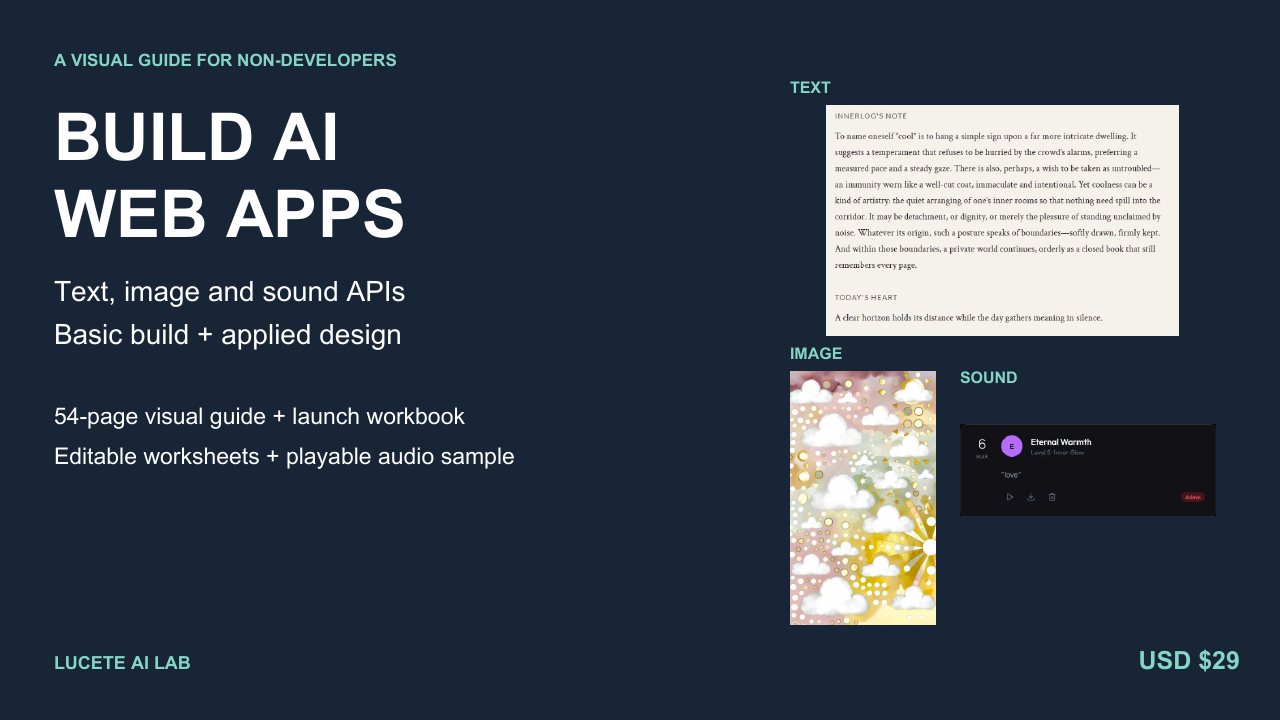
INNERLOG: an actual generated note and separate closing line show why text fields need distinct purposes. The original historical input is not shown in the archive, so the guide does not invent it.
FREQUORA: the saved input “love” and Eternal Warmth recording show the difference between generating a title and delivering playable audio. The kit includes an approximately two-minute MP3 study sample, a local playback page and a sound-review worksheet.
What the USD $29 kit contains
- 54-page illustrated guide covering text, image and sound API flows.
- 35 new build-and-design exercises for an AI coding assistant.
- Original 31-page launch and handover workbook and 12 review prompts.
- Nine editable CSV worksheets, including sound review.
- One playable audio study sample, local player and format notes.
18 files in one ZIP. Existing purchasers of the launch workbook receive the expanded materials through the same product. API accounts, generation credits, subscriptions, hosting, deployable source code and individual support are not included.
Before you share the app
- Define one release. Write the user, task, output, included pages and behaviours, exclusions, approver and evidence of completion. Avoid letting a small website turn into an undefined platform.
- Map the whole journey. Include loading, empty, validation, success and failure states. A confirmation message does not prove that a record was saved or a notification arrived.
- Write observable tests. Record the context, action, expected result, actual result and evidence. Use PASS, FAIL, NOT TESTED and NOT APPLICABLE honestly.
- Separate three recovery questions. A source commit identifies code history. A deployment identifies what is running. Data recovery concerns stored records and backups. One does not automatically restore the other two.
- Record ownership. Identify who controls the domain, source repository, hosting, database, model account and billing. Put secret credentials in an appropriate secret manager, never in a public worksheet.
- Review AI quality and cost together. Count retries and rejected outputs as well as successful results. Recheck a representative sample after changing a model or prompt.
- Make the handover usable. Provide the accepted scope, public URL, ownership record, test results, operating steps, limitations and agreed support boundaries.
Questions before buying
Can a non-developer build an AI web app with APIs?
An AI coding assistant can help write and revise a small app. You still define the input, output and success criteria, review the result and test the deployed flow. This guide starts with a labelled mock and one generator before adding more features.
What does the basic version teach?
Map the form, server request, provider result and user action. Start with structured text, then learn separate image and audio flows. Keep credentials on the server and design loading, success and failure states.
What does the applied version add?
Versioned service guides, controlled customer choices, output validation, independent generation steps, saved history, partial failure handling and cost review.
Are the examples real?
The guide shows two March 2026 Tomorrow Me cards, a creator-owned INNERLOG text result and the FREQUORA Eternal Warmth recording. Historical input records, inspected source patterns and newly written exercises are distinguished. New exercises have not been run against paid APIs.
What is included for USD 29?
A 54-page visual PDF guide, 35 build exercises, the original 31-page launch workbook, 12 review prompts, nine editable CSV worksheets and one playable sound study sample. The ZIP contains 18 files.
Is this a video course, source-code package or consultation?
No. It is an illustrated self-study guide and workbook. Private application repositories, API credits, hosting, software subscriptions and individual consulting are not included. The audio is for private study rather than use as stock music.
Need a tailored brand and service brief?
The kit is self-study. Brand strategy, website messaging and AI workflow consulting is a separate USD $3,000 engagement for one brand, offer and market. Implementation is separately scoped.
View the complete kit on Gumroad
Related resources
AI music video character planning and shot review
Pitch deck evidence and offer validation
All Lucete AI Lab resources